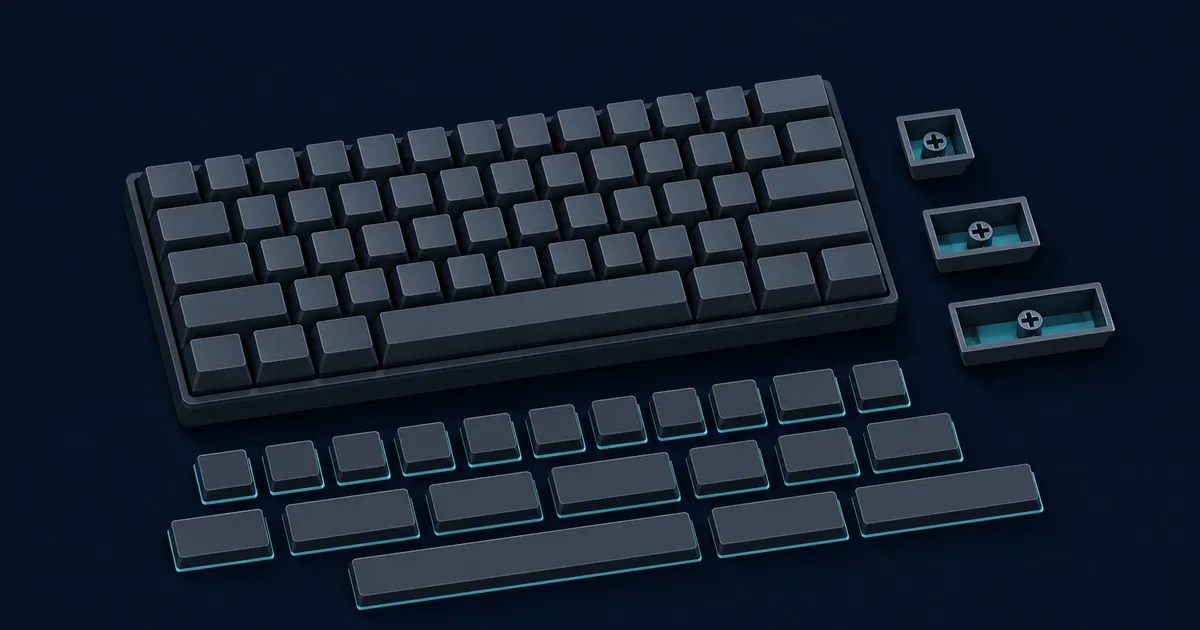
Keycap Sizes Explained: Units, Bottom Rows, Kits
Keycap sizes in units, the 19.05 mm grid behind them, the bottom rows that break compatibility, and how to check a kit covers your board before you buy.
Almost every failed keycap purchase is a sizing failure, not a taste failure. The colours arrive exactly as pictured, the profile is the one that was ordered, and then four or five keys on the bottom row have nowhere to go. Sizing is the part of a keycap set that is fully knowable in advance, and it is the part buyers most often skip.
This is the dimensional side of the subject. The shape and material side is covered in keycap profiles, plastics and stem fit.
The unit is the only real dimension
Keycap listings are written in units. A unit, written 1u, is the distance from the centre of one letter key to the centre of the next. Deskthority describes MX-mount keycaps as designed for a 0.75-inch unit size, and 0.75 inches is 19.05 mm exactly, which is where the figure quoted all over keycap listings comes from. Note what it is: a conversion of the inch figure, not a published metric specification.
It is worth knowing how weakly that number is standardised. ISO 1091 used to prescribe 19 mm ± 1 mm (or 0.75” ± 0.04”) both horizontally and vertically, but the standard was withdrawn in 1994 in favour of the ISO 9995 series, and ISO 9995 never restored a unit definition. National bodies now fill the gap themselves: German DIN keeps the figure alive in the preliminary standard DIN 2137-2 while waiting for an international ruling.
Two consequences follow, and both matter when you are checking a set against a board.
The tolerance does not accumulate. If the unit is 19 mm ± 1 mm, then the distance from the centre of Q to the centre of P, nine units apart, has to be 171 mm ± 1 mm. It is not 171 mm ± 9 mm. Keyboard grids are far more consistent across the width of a board than a naive reading of the tolerance suggests.
Vertical unit and horizontal unit are not required to be equal. On almost every full-size board they are, but a set sold for one board is not automatically correct for another simply because both call a letter key 1u.
The keycaps themselves are deliberately slightly smaller than their unit size, which is what creates the visible gap between keys. That is why measured widths in the tables below come in just under the arithmetic.
Common key widths
| Key | Width | Grid width at 19.05 mm/u |
|---|---|---|
| Letters, numbers, function row | 1u | 19.05 mm |
| Tab, backslash, standard 60% modifiers | 1.5u / 1.25u | 28.58 mm / 23.81 mm |
| Caps lock | 1.75u | 33.34 mm |
| Backspace, ANSI enter | 2u / 2.25u | 38.10 mm / 42.86 mm |
| ANSI left shift | 2.25u | 42.86 mm |
| ANSI right shift | 2.75u | 52.39 mm |
| Standard space bar | 6.25u | 119.06 mm |
| Wide space bar | 7u | 133.35 mm |
Deskthority’s catalogue of measured Cherry MX space bars lists the 6.25u part as 118 mm wide and the 7u part as 133 mm, which is the expected undercut against the grid figures above.
Where sets actually fail: the bottom row
Above the space bar row, mainstream boards agree with each other. Below it, they do not. Deskthority’s keycap documentation puts it plainly: even within a single keycap mount, keys of a given function differ in size and shape from one manufacturer to another and from one country to another, and the size of the various modifier keys varies widely by brand.
The mainstream ANSI arrangement is 1.25u for each of the modifiers flanking the space bar, with a 6.25u space bar between them. A great many enthusiast boards deviate: 1.5u modifiers with a 7u space bar, split space bars, 1u modifiers on 40% boards, or a stepped or shifted arrangement that no stock kit anticipates.
None of this is discoverable from a set’s photographs, because the photograph is always of a standard board. It is discoverable from the kit contents list, which is the page most buyers never open.
The space bar is the single worst offender
Space bar width is the easy half. Modern Western boards sit between 6 and 7 units, and the measured widths converge tightly: every documented Cherry MX 6.25u space bar in Deskthority’s list is 118 mm.
The stabiliser mounts are the hard half, and they do not converge at all. Among documented 6.25u Cherry MX space bars alone, the catalogue records variants with three mounts 50 mm apart, three mounts 42.5 mm apart, three mounts 40 mm apart, one arrangement with three mounts and no centre mount, and one with six mounts.
That is the whole problem in one line. A kit page that says “6.25u space bar” has told you the width and nothing whatsoever about whether the stabiliser stems underneath will line up with your board. Deskthority flags this explicitly as the reason aftermarket space bars fail more often than any other key: the width of the space keycap and the positions of its mounts vary between keyboards, even between keyboards using the same switches.
Before ordering, pull your existing space bar and count the stems on its underside, then note whether there is a centre mount. That single observation resolves most space bar disappointments.
ANSI, ISO, and the enter key
The enter key shape and size differ between ANSI and ISO layouts, and left shift differs with them. An ISO board needs an ISO kit; the tall enter and the shorter left shift are separate mouldings, not a rearrangement of ANSI parts. Some sets list an ISO kit as an add-on and some do not offer one at all.
Stepped keycaps, where part of the top surface sits lower than the rest, are a further wrinkle. A stepped caps lock is a different part from a flat 1.75u caps lock and the two are not interchangeable if you care how the board looks.
Stabilised keys start at 1.75u
Stabilisation is frequently applied to keys 1.75 units wide and greater. On a typical full-size US board that means both shifts, enter, backspace, and the plus, zero and enter keys on the numeric keypad. Those caps carry moulded stabiliser sockets on their undersides in addition to the switch mount.
The practical implication is that a large key is never satisfied by a cap of merely the right width. It needs the right width and the right stabiliser socket positions. This is the same failure mode as the space bar, applied to seven or eight more keys.
Uniform profiles dodge part of the problem
A uniform profile such as DSA gives every row the same shape and height, which means caps can be rearranged between rows freely. Signature Plastics’ DSA family is 0.291 inches, or 7.39 mm, on every row.
That solves layout-agnostic rearrangement, which is genuinely useful for alternative layouts. It does not solve width. A uniform-profile set with only 1.25u modifiers is exactly as wrong on a 1.5u bottom row as a sculpted one.
A pre-purchase checklist
- Photograph your board straight down, in good light.
- Write down every key that is not 1u, with its width in units.
- Note whether the enter key is ANSI or ISO.
- Pull the space bar. Measure its width, count the stems, note whether one is central.
- Open the kit contents page for the set and tick off your list against it, key by key.
- Confirm the switch mount. Most sets are cut for the MX cross stem; anything else needs its own caps.
- If the set is a tall profile, check clearance against the case lip before ordering.
Steps four and five are where the money is saved. Everything else is usually fine.
If you are buying a board partly so that keycap sets will fit it, the widest-supported target is the standard 60% bottom row: 1.25u modifiers around a 6.25u space bar. A board built to that arrangement, such as the Anne Pro 2, is covered by essentially every 60%-compatible kit on sale. It ships in several switch variants, so decide the switch first and the layout question takes care of itself.
Next steps
The keycap profile and wall thickness sizer turns a profile and material choice into set height, expected acoustic character, and a switch-orientation clearance check.
For the height and sculpting side of the decision, keycap row codes and profile heights compares the two profiles most boards ship with. If a set already arrived and something feels wrong under your fingers rather than simply not fitting, keycap wobble: causes, diagnosis and fixes works through the tolerance stack that produces loose caps.
Sources
Related

How to Fix Keycap Wobble and Loose Keycaps
Diagnose and fix a loose or wobbling keycap by checking the cap socket, switch stem, plate seating and stabiliser in the right order.

Keycap Profiles, Plastics and Stem Fit Explained
How keycap height profile, plastic choice and stem tolerance change typing feel, and the compatibility traps that ruin a keycap set purchase.

Keycap Row Codes and Profile Heights: What Is Documented
What is documented about Cherry and OEM keycap profile heights, the one cited height anchor, and the full vendor row-code table in one place.