How to Fix Keycap Wobble and Loose Keycaps
Diagnose and fix a loose or wobbling keycap by checking the cap socket, switch stem, plate seating and stabiliser in the right order.
A wobbling keycap is a tolerance problem, and tolerance problems have a small number of causes that can be separated in a couple of minutes. The reason it feels mysterious is that the single most important dimension in the whole assembly is not specified by anybody.
What the joint actually is
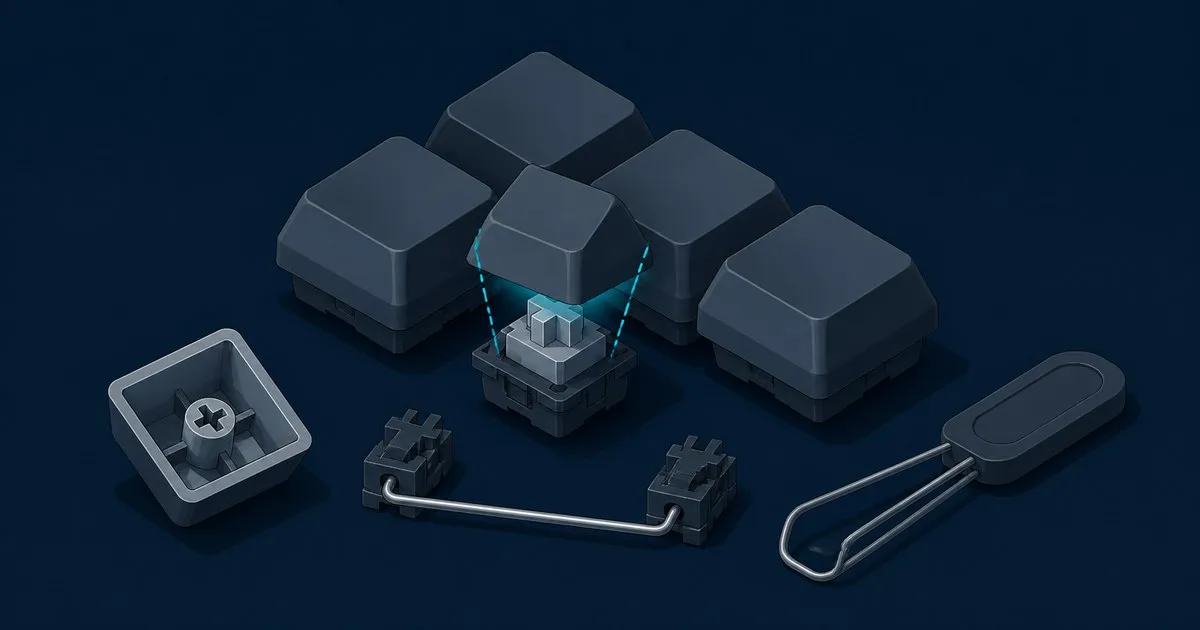
The MX mount is a cross-shaped stem on the switch’s slider pushed into a cross-shaped hole inside a cylindrical stem moulded into the underside of the keycap. Nothing clips, nothing latches. The cap is held entirely by interference between two plastic parts.
Cherry’s keycap specification gives the slot in the cap as a cross 4.1 mm wide with a tolerance of plus 0.05 mm, and arms 1.17 mm wide with a tolerance of plus or minus 0.02 mm, which makes each arm about 1.465 mm long. Signature Plastics documents its own equivalent as a cross 0.159 inches, or 4.04 mm, wide with arms 0.047 inches, or 1.19 mm.
Those two published figures already disagree, by 0.06 mm on the cross and 0.02 mm on the arms. That is small, but it is the same order of magnitude as the stated tolerance, so a cap cut to one house standard sitting on a stem cut to another is starting from a measurable mismatch.
Then comes the part that explains everything else. There are no known specifications for the switch stem. Cherry specifies the hole. Nobody has published a public specification for the peg that goes into it. Every switch manufacturer, and there are now dozens making MX-compatible switches, picks its own stem dimensions and its own tolerance band.
That is why the same keycap set is snug on one board and loose on another, and why “MX compatible” is a statement about shape rather than about fit.
Moulding shrinkage moves the target again
Keycaps are injection moulded, and the part shrinks as it cools after demoulding by an amount that depends on the plastic. The difference is large enough to drive manufacturing decisions: ABS is the preferred plastic for double-shot moulding specifically because most other plastics shrink too much for the process to hold tolerance, and some boards fit an ABS space bar even when the rest of the set is PBT or POM.
The practical consequence is that a PBT cap and an ABS cap can come out of comparable tooling with different final socket dimensions. If a PBT set feels looser or tighter than the ABS set it replaced on the same board, the plastic is a legitimate suspect and not imagination.
Diagnosis order
Work down this list and stop at the first step that changes the symptom.
- Is it one key or many? One key points at that switch, that cap, or that stabiliser. Many keys point at the set or the switch batch.
- Is the key 1.75u or wider? Stabilisation is normally applied to keys 1.75 units and above, which on a full-size board means both shifts, enter, backspace, and the plus, zero and enter keys on the keypad. Wobble on those keys is a stabiliser question first and a stem question second.
- Move the suspect cap to a neighbouring 1u switch. If the wobble follows the cap, the socket is the cause. If it stays behind, the switch is.
- Put a known-good cap on the suspect switch. This confirms step three in the other direction.
- Check the switch is fully seated in the plate. A switch that has lifted a fraction of a millimetre out of its plate cutout tilts under load and reads exactly like a loose cap.
- Look inside the cap socket. A splayed or cracked cross, usually from a previous removal, is visible against a light and is not repairable.
- Confirm the mount is genuinely MX. Cherry M8 uses a cruciform mount with the same lateral dimensions as MX but a shorter switch stem, and that shorter stem causes keycap incompatibility. Cherry produced an MX-M8 adapter switch variant precisely because the two do not interchange.
Symptom to cause
| Symptom | Most likely cause | What to do |
|---|---|---|
| One 1u key rocks, others fine | Loose socket on that cap, or a worn switch stem | Swap cap and switch in turn to isolate |
| Every key in the set rocks slightly | Stem-to-socket mismatch between set and switch brand | Live with it, shim it, or change one side |
| Cap sits low and bottoms out early | Non-MX stem height, or a cracked socket | Check for M8-style short stem; inspect socket |
| Large key tilts or binds at one end | Stabiliser play or a badly seated stabiliser | Reseat the stabiliser, check wire retention |
| Space bar rocks front to back | Stabiliser mount spacing mismatch | Check stem positions against the board |
| Cap falls off during typing | Socket cracked, or the set is not MX | Replace the cap |
Large keys are a different problem
Stabilisers exist for two reasons: they stop the key binding by keeping its motion vertical and the cap level wherever it is pressed, and they suppress the play inherent in the switch slider that would otherwise become visible wobble or tilt on larger keys, particularly the space bar. The most common design is the wire stabiliser, a stiff wire running from one end of the key to the other, connected to the cap at both ends and restrained by the plate or PCB.
When a large key wobbles, the switch stem is rarely the culprit. Either the wire has not seated in the cap’s stabiliser sockets, or the sockets in the cap are in different positions from the board’s stabiliser mounts. The second case is not fixable and is the same failure documented at length for aftermarket space bars, where mount spacing varies from board to board even between boards using the same switches. That is a purchasing problem rather than a repair problem, and it is covered in keycap sizes explained.
Removing caps without creating the next problem
Most cracked sockets are made during removal, so the tool matters.
Wire pullers, two wire loops on a handle, spread the load across the underside of the cap and are the safest common option. Plastic ring pullers with opposing prongs snap under the cap and are pulled with a finger ring; they work but the prongs bear on a small area.
Folded steel pullers, the flat ones supplied with some Topre boards and some keycap sets, should be used with caution: they have been reported to slip off keys, especially larger keys that need more force, and they can scratch the keycap wall on the way off.
The procedure that avoids damage is unglamorous. Seat the puller squarely under opposite corners, pull straight up along the switch axis rather than at an angle, and on stabilised keys ease each end up a little at a time rather than levering one end free. Never rock a cap side to side to loosen it; that is the motion that splays the cross.
Fixes that work and fixes that do not
Replacing the switch is the reliable fix when the wobble stays with the switch. Replacing the cap is the reliable fix when it follows the cap.
Shimming the socket with a sliver of tape is a widely reported workaround for a single loose cap. It is reversible and costs nothing, and it is a genuine repair rather than a bodge, but it does not scale to a whole set.
O-rings do not fix wobble. They shorten travel and soften the bottom-out sound, which is a different complaint entirely. They are also unavailable on some profiles: Signature Plastics DCS keys lack struts inside the cap around the key stem, which means down-stroke noise cannot be damped with O-rings or silencing clips at all. If your set is DCS, that route is closed before you start.
Tightening the case, changing the plate, or lubing the switch will not change a stem-to-socket mismatch, because none of them touch the joint that is loose.
When to accept it
A small amount of movement on a 1u key is normal. The joint is an interference fit between two moulded plastic parts, one of which has a published tolerance and the other of which has no published specification at all. Perfectly rigid is not what the design promises.
The threshold worth acting on is when the cap moves enough to change how the key feels under a normal press, when a legend visibly sits crooked, or when the cap comes off in use.
Next steps
The keycap profile and wall thickness sizer covers the other half of feel, where wall thickness and profile height decide how a keypress sounds and how much clearance the cap has.
For the dimensional groundwork behind fit, read keycap sizes explained. For how profile choice interacts with stem struts and case clearance, read keycap row codes and profile heights and the overview in keycap profiles, plastics and stem fit.
Sources
Related

Keycap Profiles, Plastics and Stem Fit Explained
How keycap height profile, plastic choice and stem tolerance change typing feel, and the compatibility traps that ruin a keycap set purchase.

Keycap Row Codes and Profile Heights: What Is Documented
What is documented about Cherry and OEM keycap profile heights, the one cited height anchor, and the full vendor row-code table in one place.

Keycap Sizes Explained: Units, Bottom Rows, Kits
Keycap sizes in units, the 19.05 mm grid behind them, the bottom rows that break compatibility, and how to check a kit covers your board before you buy.